- All
- Bearing technology

- Linear technology

- Gaskets and seals

- Electric cylinders - actuators

- Industrial wheels & castors

- Standard Elements

- Electric motors

- Gearboxes

- Chains and Sprockets

- Belts

- Pulleys

- Gears and Gear Racks

- Transmission couplings

- Clamping Elements

- Engineering plastics

- Technical rubber

- Hand tools

- Purpose tools

- Workshop equipment

- Measuring tools

- LED work lights

- Pneumatic gauges

- Preparation and regulation of compressed air

- Pneumatic cylinders

- Pneumatic valves

- Accessories

- Cleaning products

- Adhesives

- Adhesive sealants

- Fillers and coatings

- Dosing equipment

- Industrial lubricants

- Vehicles and construction machine lubricants

- Lubricants for garden machinery

- Nautical lubricants

- Metalworking lubricants

- Greases and pastes

- Lubrication equipment

- Oil analysis

- Promotions and discounts
- Machine elementsCategoriesBearing technologyLinear technologyGaskets and sealsElectric cylinders - actuatorsIndustrial wheels & castorsStandard Elements
- Show all
- Retaining Rings – Circlips
- Dowel Pins
- Spring Pins
- Rubber Dampers
- Leveling Feet
- Fasteners
- Handwheels, Crank Handles
- Clamping Levers, Tension Levers
- Fixed, Rotating and Folding Handles
- Gripping Handles
- Industrial Hinges
- Control Handles
- Quick Clamps, Power Clamps, Tension Latches
- Indexing Elements
- Latches
- Adjustment Elements, Rotating Knobs, Adjustment Slides
- Magnets
- Rotary Controls
- Other Standard Machine Elements
- Promotions and discounts
Rolling bearings- Show all
- Deep groove ball bearings
- Angular contact ball bearings
- Spindle bearings
- Four-point contact ball bearings
- Self-aligning ball bearings
- Cylindrical roller bearings
- Tapered roller bearings
- Spherical roller bearings
- Needle roller bearings
- Inner rings
- Axial deep groove ball bearings
- Axial cylindrical roller bearings
- Axial needle roller bearings
- Axial spherical roller bearings
- Crossed roller bearings
- Track rollers
- Bearings for screw drives
- Precision bearings for combined loads
Housing unitsBearing housingsOther bearingsAccessoriesLinear guidesBall screws - spindlesLinear round shaftLinear modulesOtherRadial shaft seals and accessoriesHydraulic sealsBraided packingsMechanical sealsV-ring and other axial sealsX-ring sealsDC electric actuatorsAccessories for actuatorsGeneral purpose castorsCastors for rough floorsHeavy duty castorsStainless steel castorsCastors for mobile waste containersTemperature resistance castorsInstitutional castors and wheelsFurniture castors and wheelsRetaining Rings – CirclipsDowel PinsSpring PinsRubber DampersLeveling FeetFastenersHandwheels, Crank HandlesClamping Levers, Tension LeversFixed, Rotating and Folding HandlesGripping HandlesIndustrial HingesControl HandlesQuick Clamps, Power Clamps, Tension LatchesIndexing ElementsLatchesAdjustment Elements, Rotating Knobs, Adjustment SlidesMagnetsRotary ControlsOther Standard Machine Elements - Power transmissionCategoriesElectric motorsGearboxesChains and SprocketsBeltsPulleysGears and Gear RacksTransmission couplingsClamping ElementsSingle phase induction motorsThree phase induction motorsMotor mountingFrequency inverter regulatorsGearbox accessoriesWorm gear boxesPlanetary gearboxesHelical and helical bevel gearboxesVariatorsGeared motorsGall ChainsLeaf ChainsChain LinksSprocketsChain TensionersChain GuidesChain TightenersV-beltsTiming beltsPoly V-beltVariator beltsAutomotive beltsAgricultural beltsBelt profiles for drive and transportFlat beltsConnecting plates for timing beltsV-Belt PulleysTiming Belt PulleysTiming Belt BarsFlanges for Timing Belt PulleysRibbed PulleysVariator PulleysGear RacksBevel GearsCylindrical GearsJaw couplingsElastomer couplingsChain couplingsRigid shaft couplingsRubber tyre couplingsGear couplingsCardan couplingsTaper Lock BushingsHubs for TL BushingsScrews for TL BushingsClamping Rings
- Technical plastics and rubberCategoriesEngineering plasticsTechnical rubberPE plastics (polyethylene)PA plastics (Nylon)POM plasticsPP plasticsPTFE plasticsPET plasticsPEEK plasticsPVDF plasticsPSU plasticsRubber with a smooth surfacePatterned rubber flooringStable rubber flooring
- ToolsHand toolsPurpose toolsWorkshop equipmentMeasuring toolsScrewdriversWrenches and RatchetsPliersKnives, blades and sawspoints, chisels and punchesHammersLeversThreading drillsTool setsDrilling machinesHydraulic liftsWheelbarrowsBearing toolsDiagnostics instrumentsTools for seals & gasketsTools for beltsTools for chainsLiner stripsTools for conveyor beltsOther toolsWork glovesWarehouse boxesMarkers and marker coloursZinc spraysAcrylic coloursLeak detectorsTrolleys, cases and tool bagsOther workshop equipmentMeters and gaugesMeasuring slipsOther measuring toolsHand lampsHeadlampsLED floodlightsLED headlights
- PneumaticsCategoriesPreparation and regulation of compressed airPneumatic cylindersPneumatic valvesAccessoriesPneumatic gaugesAccessories for pneumatic gaugesCompressed air service systemsFilter regulatorsPressure regulatorsOilersFiltersHosesFittings and connectorsHose clampsCompressed air gunsNoise dampersVacuum technology
- Cleaners and adhesivesCleaning productsAdhesivesAdhesive sealantsFillers and coatingsDosing equipmentBrake cleanersIndustrial cleaners and degreasersRemoversContact spraysSurface preparation productsAbsorption agentsHand cleanersAutocosmeticsBolt guardsAdhesives for joining cylindrical partsQuick-setting adhesivesUniversal adhesivesAcrylic adhesivesEpoxy adhesivesPolyurethane adhesivesHybrid adhesivesPurpose adhesivesUV adhesivesActivators and primers for adhesivesAdhesive tapesThread sealsSiliconesElastic sealantsLiquid gaskets for flangesLiquid metalsEpoxy coatingsMixing pointsDosing needlesDosing gunsOther dosing equipment
- Lubricants and equipmentCategoriesIndustrial lubricantsVehicles and construction machine lubricantsLubricants for garden machineryNautical lubricantsMetalworking lubricantsGreases and pastesLubrication equipmentOil analysisHydraulic oilsSlideway and sliding oilsIndustrial gear oilsCompressor oilsCirculating oilsHeat transfer oilsChain lubricantsGas engine oilsMultipurpose lubricantsRelease agentsUniversal silicone oilsOther lubricantsEngine oilsGearbox and differential oilsUniversal tractor and construction machine oilsFunctional liquidsOther agents for vehicle maintenanceEngine oils for garden machineryOils for chainsaw chainsMarine engine oilsOther marine lubricantsPenetrating oilsCorrosion protective agentsWelding agentsCutting agentsEmulsions for metalworkingPunching oilsOils for transformationErosion fluidQuenching oilsAdditives for emulsionsGrease equipmentOil equipmentAdBlue equipmentEquipment for chemicals


LOCTITE threadlockers for reliable machine operation

Even a single loose screw can cause an unplanned machine shutdown, additional maintenance work or equipment damage. LOCTITE threadlockers help prevent metal threaded fasteners from loosening spontaneously due to vibration and impact. Their purpose is not only to secure the screw, but also to maintain clamping force and protect threads. Choosing the right adhesive during the planning of assembly and maintenance is therefore essential.
A Small Joint with a Major Impact on Machine Performance
In pumps, compressors, electric motors and gearboxes, the stability of threaded joints is an important factor in reliable operation. When a fastener starts to loosen, the consequences are not limited to a single screw: components may shift, readjustment may be required and unplanned downtime may occur. Threadlocking is therefore a preventive measure, not just a solution applied after a problem has arisen.
LOCTITE sums this up with the message “Reliability starts here.” In industrial assembly, this means carefully selecting the appropriate locking method before equipment is commissioned, while taking into account the joint requirements and planned maintenance needs.
VIEW THREADLOCKERS IN THE ONLINE SHOP
How Do Anaerobic Threadlockers Work?
Anaerobic adhesives cure in the absence of air when confined between closely fitting metal surfaces. After application and assembly, they fill the gaps between the threads of a screw and nut or a threaded hole. The cured adhesive bonds the threaded surfaces together, preventing relative movement and spontaneous loosening caused by vibration.
Unlike mechanical locking devices, which act at individual contact points, the adhesive works within the threaded joint itself. In addition to locking the joint, it creates a protective barrier that helps prevent corrosion and thread seizure. Filling the gaps also restricts the passage of liquids through the thread. However, threadlocking for fasteners should not be confused with sealing threaded pipe connections: these require a suitable dedicated thread sealant.
More Than Just Protection Against Loosening
For maintenance purposes, it is important that a correctly selected threadlocker combines vibration resistance, thread protection and the possibility of planned disassembly. Low- and medium-strength grades allow disassembly with conventional hand tools, so using an adhesive does not necessarily mean creating a permanently non-removable joint.
Within its technical limitations, one product can be used for several sizes of threaded fasteners. This can simplify threadlocker stock management and reduce the need for additional mechanical locking components in different sizes. The greatest benefit, however, is preventing problems that could require reassembly, repairs or production interruptions.
VIDEO: See how LOCTITE threadlockers protect threaded joints >>
Where Are Threadlockers Used in Industry?
Typical applications include fastening screws on pumps and motors, bearing housing screws, adjustment screws, threaded studs, and screws on couplings and flanges. They are also used to secure pump impellers and in other threaded joints in machinery. For every application, the assembly design, thread material, operating temperature and equipment manufacturer's requirements must be taken into account.
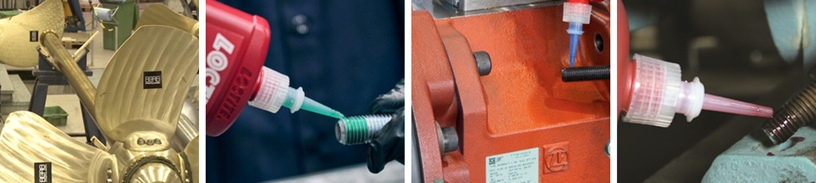
Typical applications
Proper Preparation and Application Determine the Result
Before applying the product, remove contaminants and degrease the threads if necessary. A product's tolerance of small amounts of residual oil does not mean that it is suitable for heavily contaminated surfaces. Apply the adhesive to the contact area between the threads, assemble the joint and tighten it to the specified tightening torque. For joints that have already been assembled, use a product specifically designed for this type of application.
Initial fixture strength is not the same as full cure. Before loading the joint, observe the curing time specified in the technical data sheet. Curing time is affected by the selected adhesive, the metal surface and the temperature. An activator may be useful under certain conditions, but only in accordance with the instructions for the specific product. Using a threadlocker does not replace proper joint design or the prescribed assembly procedure.
Which LOCTITE Threadlocker Should You Choose?
Maximum strength is not always the best choice. A joint that is regularly disassembled during servicing requires a different approach from a threaded stud intended for permanent locking. Other important factors include thread size, adhesive viscosity, the material and condition of the surface, and whether the adhesive is applied before assembly or to a joint that has already been assembled.
|
Product / Strength |
Typical Application |
Disassembly |
Temperature Range |
|---|---|---|---|
|
LOCTITE 222 |
Small adjustment and fastening screws where easy disassembly is important. |
With conventional hand tools. |
from -55°C |
|
LOCTITE 243 |
General-purpose locking of metal screws and nuts in industrial assembly and maintenance. |
With conventional hand tools. |
from -55°C |
|
LOCTITE 270 |
Permanent locking of screws, nuts and threaded studs that are not intended for regular disassembly. |
Local heating may be required for disassembly. |
from -55°C |
|
LOCTITE 290 |
Post-assembly locking of threaded joints using the adhesive's capillary action. |
Disassembly by heating, following the manufacturer's instructions. |
from -55°C |
The data applies to the products listed. For application and disassembly, consult the current technical data sheet.
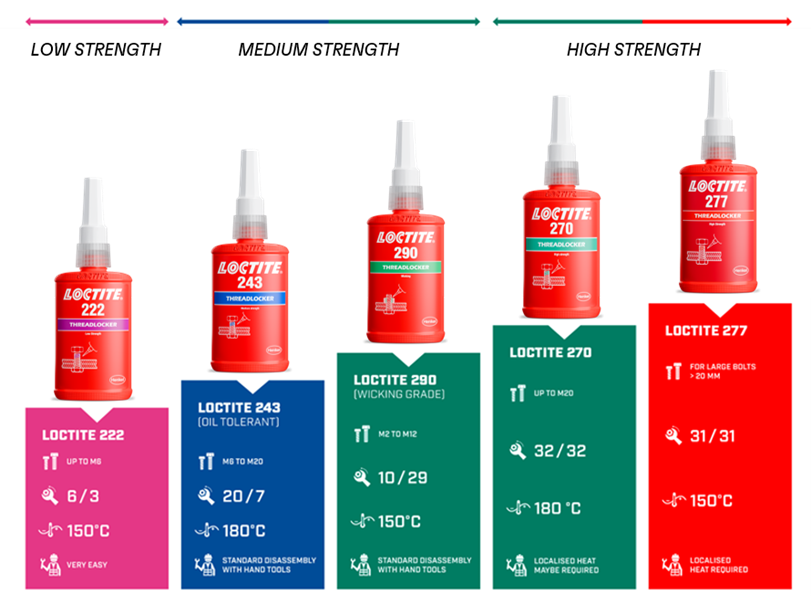
Comparison of LOCTITE threadlockers by strength, thread size and disassembly method
LOCTITE 243 is a practical choice for general industrial maintenance when medium strength and subsequent disassembly with hand tools are required. It is also suitable for passive metal surfaces such as stainless steel and aluminium, and tolerates small amounts of certain residual oils. In addition to the 50 ml package, the online shop also offers LOCTITE 243 in a 250 ml package.
Colour alone is not sufficient for product selection. For example, both LOCTITE 270 and LOCTITE 290 are green, but the former is intended for high-strength locking, while the latter, thanks to its low viscosity and capillary action, is primarily intended for post-assembly locking of joints that have already been assembled. The product designation and its technical data sheet are the decisive factors.
Renewed Formulations and Packaging Containing Recycled Plastic
For the new generation of selected LOCTITE threadlockers, Henkel highlights renewed formulations without CHP and APH ingredients. The European product range also includes LOCTITE 243 and LOCTITE 270. According to the manufacturer, the reformulation retains key properties such as viscosity, torque and shear strength, and temperature resistance. The focus is on improving the formulations without compromising the required technical performance.
The change also includes new bottles for anaerobic products in 50 ml and 250 ml sizes containing 50% post-consumer recycled plastic (PCR). In this way, Henkel replaces part of the virgin plastic with recycled material. This is a specific packaging improvement, separate from the function of the adhesive in the threaded joint.
These updates apply to the renewed product versions. When selecting and using a product, always check the current technical data sheet and safety data sheet for the specific product, as well as the information on the packaging. A renewed formulation does not remove the requirements for safe handling.
Choose the Right Threadlocker Before a Screw Causes Downtime
A reliable threaded joint is the result of correct product selection, surface preparation and assembly. Explore the M&M Intercom range to find the LOCTITE threadlocker suited to your operating conditions: from low-strength products for small screws to high-strength grades and products designed for post-assembly application.
Need help choosing? Tell us the thread dimensions and material, operating temperature and intended disassembly method. We will advise you on selecting the right product for your application.
Related content:
Text and image source: Henkel. Product information and links: M&M Intercom online shop.

NOT SURE WHICH LOCTITE THREADLOCKER TO CHOOSE?
Choosing the right threadlocker depends on the thread size, required strength, temperature and maintenance requirements. Send us the details of your application, and the M&M Intercom team will advise you on selecting the appropriate LOCTITE product.