


- All
- Bearing technology

- Linear technology

- Gaskets and seals

- Electric cylinders - actuators

- Industrial wheels & castors

- Standard Elements

- Electric motors

- Gearboxes

- Chains and Sprockets

- Belts

- Pulleys

- Gears and Gear Racks

- Transmission couplings

- Clamping Elements

- Engineering plastics

- Technical rubber

- Hand tools

- Purpose tools

- Workshop equipment

- Measuring tools

- LED work lights

- Pneumatic gauges

- Preparation and regulation of compressed air

- Pneumatic cylinders

- Pneumatic valves

- Accessories

- Cleaning products

- Adhesives

- Adhesive sealants

- Fillers and coatings

- Dosing equipment

- Industrial lubricants

- Vehicles and construction machine lubricants

- Lubricants for garden machinery

- Nautical lubricants

- Metalworking lubricants

- Greases and pastes

- Lubrication equipment

- Oil analysis

- Promotions and discounts
- Machine elementsCategoriesBearing technologyLinear technologyGaskets and sealsElectric cylinders - actuatorsIndustrial wheels & castorsStandard Elements
- Show all
- Retaining Rings – Circlips
- Dowel Pins
- Spring Pins
- Rubber Dampers
- Leveling Feet
- Fasteners
- Handwheels, Crank Handles
- Clamping Levers, Tension Levers
- Fixed, Rotating and Folding Handles
- Gripping Handles
- Industrial Hinges
- Control Handles
- Quick Clamps, Power Clamps, Tension Latches
- Indexing Elements
- Latches
- Adjustment Elements, Rotating Knobs, Adjustment Slides
- Magnets
- Rotary Controls
- Other Standard Machine Elements
- Promotions and discounts
Rolling bearings- Show all
- Deep groove ball bearings
- Angular contact ball bearings
- Spindle bearings
- Four-point contact ball bearings
- Self-aligning ball bearings
- Cylindrical roller bearings
- Tapered roller bearings
- Spherical roller bearings
- Needle roller bearings
- Inner rings
- Axial deep groove ball bearings
- Axial cylindrical roller bearings
- Axial needle roller bearings
- Axial spherical roller bearings
- Crossed roller bearings
- Track rollers
- Bearings for screw drives
- Precision bearings for combined loads
Housing unitsBearing housingsOther bearingsAccessoriesLinear guidesBall screws - spindlesLinear round shaftLinear modulesOtherRadial shaft seals and accessoriesHydraulic sealsBraided packingsMechanical sealsV-ring and other axial sealsX-ring sealsDC electric actuatorsAccessories for actuatorsGeneral purpose castorsCastors for rough floorsHeavy duty castorsStainless steel castorsCastors for mobile waste containersTemperature resistance castorsInstitutional castors and wheelsFurniture castors and wheelsRetaining Rings – CirclipsDowel PinsSpring PinsRubber DampersLeveling FeetFastenersHandwheels, Crank HandlesClamping Levers, Tension LeversFixed, Rotating and Folding HandlesGripping HandlesIndustrial HingesControl HandlesQuick Clamps, Power Clamps, Tension LatchesIndexing ElementsLatchesAdjustment Elements, Rotating Knobs, Adjustment SlidesMagnetsRotary ControlsOther Standard Machine Elements - Power transmissionCategoriesElectric motorsGearboxesChains and SprocketsBeltsPulleysGears and Gear RacksTransmission couplingsClamping ElementsSingle phase induction motorsThree phase induction motorsMotor mountingFrequency inverter regulatorsGearbox accessoriesWorm gear boxesPlanetary gearboxesHelical and helical bevel gearboxesVariatorsGeared motorsGall ChainsLeaf ChainsChain LinksSprocketsChain TensionersChain GuidesChain TightenersV-beltsTiming beltsPoly V-beltVariator beltsAutomotive beltsAgricultural beltsBelt profiles for drive and transportFlat beltsConnecting plates for timing beltsV-Belt PulleysTiming Belt PulleysTiming Belt BarsFlanges for Timing Belt PulleysRibbed PulleysVariator PulleysGear RacksBevel GearsCylindrical GearsJaw couplingsElastomer couplingsChain couplingsRigid shaft couplingsRubber tyre couplingsGear couplingsCardan couplingsTaper Lock BushingsHubs for TL BushingsScrews for TL BushingsClamping Rings
- Technical plastics and rubberCategoriesEngineering plasticsTechnical rubberPE plastics (polyethylene)PA plastics (Nylon)POM plasticsPP plasticsPTFE plasticsPET plasticsPEEK plasticsPVDF plasticsPSU plasticsRubber with a smooth surfacePatterned rubber flooringStable rubber flooring
- ToolsHand toolsPurpose toolsWorkshop equipmentMeasuring toolsScrewdriversWrenches and RatchetsPliersKnives, blades and sawspoints, chisels and punchesHammersLeversThreading drillsTool setsDrilling machinesHydraulic liftsWheelbarrowsBearing toolsDiagnostics instrumentsTools for seals & gasketsTools for beltsTools for chainsLiner stripsTools for conveyor beltsOther toolsWork glovesWarehouse boxesMarkers and marker coloursZinc spraysAcrylic coloursLeak detectorsTrolleys, cases and tool bagsOther workshop equipmentMeters and gaugesMeasuring slipsOther measuring toolsHand lampsHeadlampsLED floodlightsLED headlights
- PneumaticsCategoriesPreparation and regulation of compressed airPneumatic cylindersPneumatic valvesAccessoriesPneumatic gaugesAccessories for pneumatic gaugesCompressed air service systemsFilter regulatorsPressure regulatorsOilersFiltersHosesFittings and connectorsHose clampsCompressed air gunsNoise dampersVacuum technology
- Cleaners and adhesivesCleaning productsAdhesivesAdhesive sealantsFillers and coatingsDosing equipmentBrake cleanersIndustrial cleaners and degreasersRemoversContact spraysSurface preparation productsAbsorption agentsHand cleanersAutocosmeticsBolt guardsAdhesives for joining cylindrical partsQuick-setting adhesivesUniversal adhesivesAcrylic adhesivesEpoxy adhesivesPolyurethane adhesivesHybrid adhesivesPurpose adhesivesUV adhesivesActivators and primers for adhesivesAdhesive tapesThread sealsSiliconesElastic sealantsLiquid gaskets for flangesLiquid metalsEpoxy coatingsMixing pointsDosing needlesDosing gunsOther dosing equipment
- Lubricants and equipmentCategoriesIndustrial lubricantsVehicles and construction machine lubricantsLubricants for garden machineryNautical lubricantsMetalworking lubricantsGreases and pastesLubrication equipmentOil analysisHydraulic oilsSlideway and sliding oilsIndustrial gear oilsCompressor oilsCirculating oilsHeat transfer oilsChain lubricantsGas engine oilsMultipurpose lubricantsRelease agentsUniversal silicone oilsOther lubricantsEngine oilsGearbox and differential oilsUniversal tractor and construction machine oilsFunctional liquidsOther agents for vehicle maintenanceEngine oils for garden machineryOils for chainsaw chainsMarine engine oilsOther marine lubricantsPenetrating oilsCorrosion protective agentsWelding agentsCutting agentsEmulsions for metalworkingPunching oilsOils for transformationErosion fluidQuenching oilsAdditives for emulsionsGrease equipmentOil equipmentAdBlue equipmentEquipment for chemicals
Fuel containers – tanks and containers for fuel storage and transport
(20)

What is a fuel container and what is it used for?
A fuel container is a purpose-designed canister or tank used to store, carry or transfer specific types of fuel. It is used to refuel passenger and commercial vehicles, agricultural machinery, construction equipment, generators and various types of industrial equipment.
Depending on their intended use, we distinguish between smaller portable fuel containers and larger mobile or stationary tanks.
Smaller petrol and diesel containers are primarily suitable for occasional refilling and transporting limited amounts of fuel. Larger tanks enable organised refuelling of vehicles and machinery at worksites, farms or industrial facilities.
When selecting a suitable container, consider the fuel type, capacity, container material, closure system and conditions of use.
Suitability for transport or storage is also important, since not all containers are designed for the same fuels or necessarily meet the same technical and legal requirements.
M&M Intercom offers a broad range of fuel containers and tanks for various users, mainly products from Pressol and CEMO.
Main features of high-quality fuel containers
When choosing a fuel container, it is important that it is made from a suitable material and designed for the intended application.
When used correctly, high-quality purpose-made containers can make fuel easier to carry, enable controlled filling and reduce the risk of accidental leakage.
Key features include:
- a construction suitable for the specified fuel type,
- different capacities to meet different needs,
- robust metal or polyethylene materials,
- a suitable closure for the filling opening,
- the option of using a flexible or rigid spout,
- convenient carrying handles on smaller containers,
- material resistance to the specified liquids,
- suitability for refuelling vehicles and machinery,
- larger versions equipped with electric pumps,
- the option of monitoring fuel flow or quantity,
- different transport and installation configurations,
- availability of specialised solutions for diesel and AdBlue.
Convenience is particularly important for smaller containers, while larger tanks also require consideration of transport arrangements, pumping equipment and safe installation requirements.
For flammable liquids, use only containers whose manufacturers expressly confirm their suitability for the specific fuel.
Types of fuel containers by material
Our product range includes metal and plastic fuel containers, which differ in construction, weight, use and technical properties.
Select the container material based on the type of liquid, expected loads and requirements for handling or storage.
Polyethylene plastic fuel containers
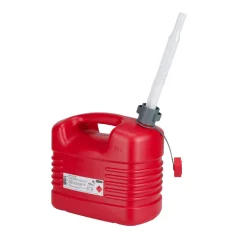
Plastic fuel containers are often made from polyethylene (PE), while some versions use high-density polyethylene (HDPE).
Such containers have a relatively low empty weight and are suitable for carrying and dispensing fuel when appropriately designed and approved for this purpose.
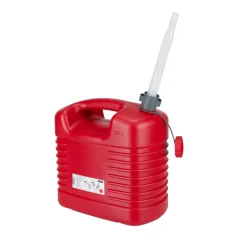
We offer Pressol plastic containers in various capacities, including 5, 10 and 20 litres.
Some models feature a flexible spout, which makes it easier to fill different types of fuel openings.
Certain PE containers also have specially designed closures and integrated spout storage.
During use, make sure that the container is undamaged, its cap is properly closed and it is used only for the fuel for which it is specified.
Metal fuel containers
Metal fuel containers offer a traditional, robust solution for carrying certain types of fuel.
Metal containers are often used in workshops, service operations, agriculture and other environments requiring durable, purpose-built containers.
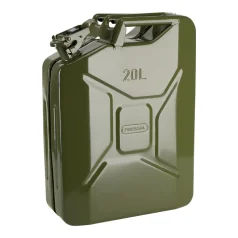
At M&M Intercom, we offer Pressol metal containers with capacities of 5, 10 and 20 litres.
When choosing, check the quality of the closure, the condition of the container, any internal protective coating and its suitability for the intended fuel.
Protect metal containers against damage and corrosion, and use them in accordance with the manufacturer's instructions.
5 L fuel container – for smaller fuel quantities
A 5 L fuel container is practical for users who need a small amount of petrol or diesel for suitable equipment.
It can be used to refuel garden machinery, smaller agricultural equipment, generators and other devices.
The smaller capacity makes carrying easier, provided the container is properly closed and used in accordance with instructions.
Our range includes, among others:
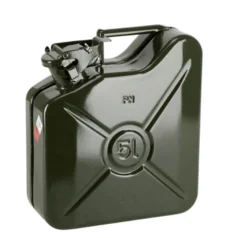
- Pressol 5 L metal container, product code 21 050,
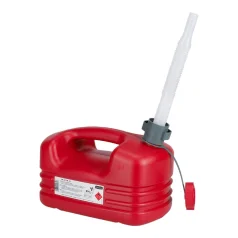
- Pressol 5 L PE container with flexible spout, product code 21 131.
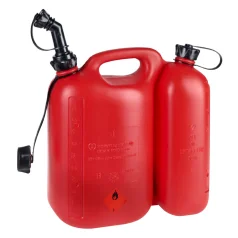
A special dual-chamber container with a capacity of 5 L + 3 L is also available.
In addition to capacity, we recommend checking the shape of the spout, closure system and suitability for the specific liquid.
10 L fuel container – a practical solution for regular use
A 10 L fuel container is a useful choice for individuals and businesses requiring a somewhat larger quantity of fuel for occasional or regular refilling.
This capacity allows fuel to be carried without the need for a larger transport tank.
The M&M Intercom range includes, among others:
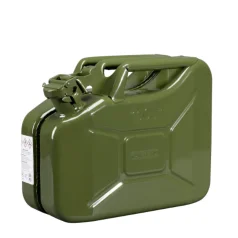
- Pressol 10 L metal container, product code 21 055,
- Pressol 10 L polyethylene container with flexible spout, product code 21 133.
When choosing between metal and plastic containers, consider their intended use, weight, fuel type and ease of handling.
A 10 L fuel jerry can may be suitable for refuelling generators, garden machinery and other compatible equipment when safe fuel-handling requirements are met.
20 L fuel container – larger portable capacity
A 20 L fuel container is intended for users who need to carry a larger quantity of fuel in a portable container.
It is often used to supply agricultural and construction machinery and other equipment where direct access to a fuel dispenser is not always available.
We offer several Pressol versions:
- 20 L PE container with flexible spout, product code 21 137,
- 20 L metal container, product code 21 060 950,
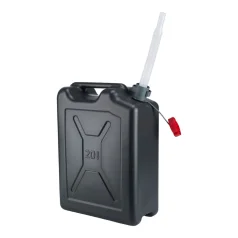
- 20 L PE container in a military-style design, product code 21 127.
With a 20-litre container, special attention must be paid to the weight when full, proper handling and prevention of spills.
The container must be properly sealed and secured against tipping, particularly during transport.
For the Pressol 21 137 container, the manufacturer specifies HDPE material, a flexible spout and UN approval for the prescribed use.
Dual-chamber fuel container 5 L + 3 L
Dual-chamber fuel containers form a distinct category, with two separate compartments for liquids.
M&M Intercom offers the Pressol 5 L + 3 L dual-chamber PE container with a rigid spout, product code 21 030.
This version is particularly useful when equipment users need to bring two different liquids to a worksite.
It is important to check which liquids the manufacturer permits in each compartment individually.
The dual-chamber design can be practical when working with suitable motor-powered equipment and other machinery because it reduces the need for two separate containers.
However, do not assume that both compartments are suitable for any combination of fuels and lubricants. Use them only for their declared purposes.
Petrol jerry cans and diesel jerry cans – what is the difference?
When buying a fuel jerry can, check whether the chosen container is suitable for petrol, diesel or both liquids.
Petrol and diesel have different physical properties, particularly concerning flammability and vapour formation.
Containers must therefore be designed and approved for the specific fuel type.
It is not enough for a container simply to be made of plastic or metal. The material, closure mechanism, design and any transport approvals are also important.
Check the declared intended use on the container or in its technical documentation.
Pay particular attention to fuel labelling to prevent accidental confusion between petrol and diesel.
Mobile fuel tanks – refuelling machinery in the field
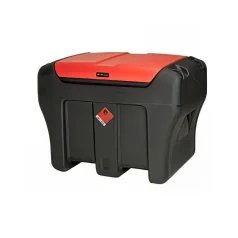
A mobile fuel tank is designed for the organised transport or supply of fuel to machinery and vehicles when filling directly at a filling station is impractical.
These solutions are particularly useful for construction machinery, agricultural equipment, forestry machinery and other mobile equipment.
Mobile tanks have substantially higher capacities than smaller portable containers.
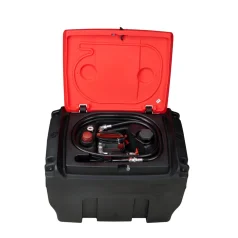
They often include an electric pump, dispensing hose and suitable dispensing nozzle.
M&M Intercom offers various mobile diesel tanks, including capacities of 300, 440, 450 and 900 litres.
When choosing, check the capacity, pump power supply, flow rate, tank design and transport conditions.
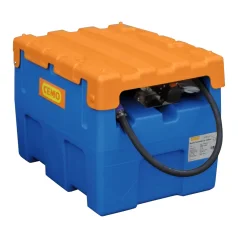
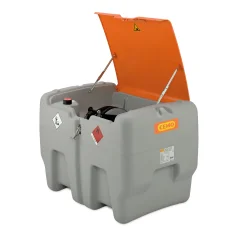
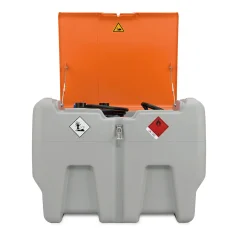
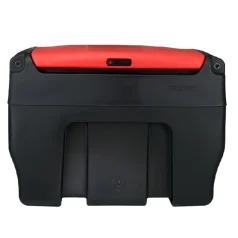
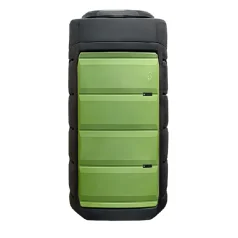
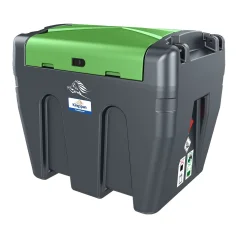
CEMO DT-Mobile Easy 440 L mobile tank
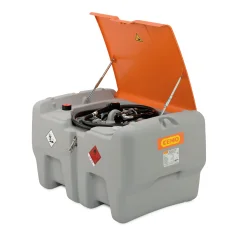
Our range includes the CEMO DT-Mobile Easy 440 L mobile tank, intended for refuelling suitable diesel-powered machinery.
Various versions are available, including models with a 12 V pump and a declared maximum flow rate of 40 L/min.
Certain models also include a lid or other accessories.
A 440-litre mobile tank can be a practical solution for businesses that regularly refuel machinery at construction sites or other workplaces.
For version 10988, the manufacturer specifies a polyethylene tank, a 12 V electric pump, an automatic dispensing nozzle and a maximum flow rate of 40 L/min.
Please note that use under the conditions of the ADR 1.1.3.1(c) exemption is permitted only for journeys that actually meet all applicable requirements. This depends on the amount of fuel, purpose of transport and suitability of the tank.
300 L mobile fuel tank
A 300 L fuel tank is suitable for users who need more diesel but do not require the largest tank capacities.
Our range includes Pressol mobiFITT 300 L mobile tanks.
Available versions include:
- Pressol mobiFITT 300 L, product code 26 485,
- Pressol mobiFITT 300 L, product code 26 480.
These products include pumping equipment with a 12 V power supply and a flow rate of 35 L/min.
This configuration is useful for refuelling suitable agricultural and construction machinery and other equipment in the field.
When selecting a tank, also check its dimensions and suitability for the vehicle or load platform.
450 L mobile fuel tank
A 450 L mobile fuel tank is another option for users with higher diesel consumption.
At M&M Intercom, we offer the Pressol mobiMASTER 450 L model, product code 26 410.
The product includes pumping equipment with a 12 V supply and a declared flow rate of 35 L/min.
This capacity makes it possible to supply several machines or operate equipment for longer without frequently refilling the tank.
During transport, particular attention must be paid to the actual fuel quantity, transport documentation, transport category and applicable ADR requirements.
Before use, check the permissible vehicle load, correct installation and secure fastening of the tank.
Larger fuel tanks – 900 and 1500 L
Larger diesel tanks are also available for users with higher fuel consumption.
Our range includes, among others:
- the TRUCKMASTER 900 L mobile tank with a 12 V supply and a K24 digital meter,
- the Pressol 1500 L tank with a 230 V supply and a declared flow rate of 60 L/min.
These systems are suitable for the organised supply of fuel to larger fleets of vehicles or machinery when used according to their declared purpose.
For larger tanks, distinguish between equipment intended for storage and equipment that also has the necessary approvals for transport.
Site conditions, fire safety, protection against fuel leaks and any environmental requirements are also particularly important.
Fuel tank with pump
A fuel tank with a pump provides easier and more controlled fuel transfer than manually pouring from large containers.
Our range includes various models with electric pumps, mainly powered by 12 V or 230 V.
Pumping systems differ in flow rate, power supply and accessories.
The products listed include pumps with declared flow rates of 30, 35, 40 and 60 L/min.
When choosing, consider:
- fuel type,
- required transfer quantity,
- hose length and diameter,
- supply voltage,
- connection method,
- type of dispensing nozzle,
- any flow meter,
- conditions of use and transport.
The stated flow rates are technical specifications for individual products. Actual flow may depend on system configuration and operating conditions.
Combined tanks for diesel and AdBlue
Many modern diesel vehicles and mobile machines require AdBlue as well as diesel fuel.
For these users, combined solutions that enable both liquids to be supplied are particularly useful.
Our range includes the CEMO DT-Mobile Easy COMBI 440/50 L, which provides separate capacities of 440 litres of diesel and 50 litres of AdBlue.
This arrangement can simplify the supply of vehicles and machines fitted with an SCR system.
It is essential that diesel and AdBlue have completely separate storage and dispensing systems.
The two liquids must not be mixed, and the equipment must be suitable for the respective fluid.
With combined systems, check the exact technical specifications of the chosen version, as pumps and accessories may vary.
Mobile AdBlue tank
An AdBlue tank must be made from materials compatible with aqueous urea solution and designed to prevent contamination.
AdBlue is not a fuel, so conventional diesel or petrol dispensing equipment should not be used unless expressly suitable for AdBlue.
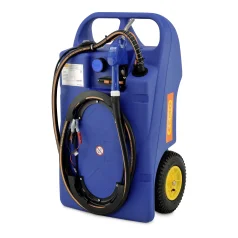
M&M Intercom offers, among others, a 100 L CEMO mobile AdBlue tank with wheels and a 12 V pump.
The CEMO Blue-Mobil Easy 200 L is also available, with a 12 V pump and a declared flow rate of 30 L/min.
These tanks are useful for supplying AdBlue to commercial vehicles, agricultural machinery and other machines equipped with SCR systems.
When choosing, consider the required fluid cleanliness, temperature conditions and system manufacturer's recommendations.
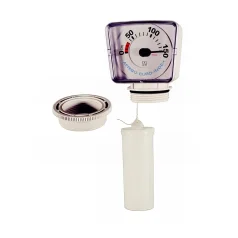
Fuel level gauges and accessories
For larger tanks, monitoring the quantity of fuel available is important.
A fuel level gauge indicates the amount of liquid or its level in the tank, depending on the design.
We also offer a Pressol analogue fuel level gauge for 1250 L tanks, product code 88 046.
This equipment supports refuelling planning and fuel stock monitoring.
Some systems also use digital flow meters to measure the quantity of fuel dispensed.
It is important to distinguish between a tank level gauge and a meter measuring fuel delivered, as they serve different purposes.
Pressol fuel containers
Pressol is one of the key manufacturers represented in our range of fuel storage and dispensing equipment.
We offer various Pressol cans and jerry cans, from smaller 5-litre models to 20-litre containers.
Metal and PE versions are available, and individual products include flexible or rigid spouts.
The range is complemented by larger mobile tanks such as mobiFITT and mobiMASTER and additional equipment.
The different models enable us to meet the needs of individual users, workshops, farms and businesses with higher fuel consumption.
CEMO fuel tanks
CEMO is represented in our range mainly through various mobile tanks for diesel and AdBlue.
These include DT-Mobile Easy tanks, COMBI dual-fluid models and specialised AdBlue systems.
Such solutions are useful for organised refuelling of machinery, particularly where larger amounts of fuel are needed in the field.
When selecting a product, it is important to know its exact designation, declared capacity, pump type and conditions of use.
A correctly selected tank and suitable equipment can simplify fuel supply for construction and agricultural machinery.
Safe fuel storage
When using fuel containers, remember that petrol, diesel and other flammable liquids present risks of fire, spillage and environmental contamination.
They must therefore be stored in properly labelled, closed containers designed for the specific fuel type.
Pay particular attention to storage location, temperature, ventilation and proximity to ignition sources.
Protect containers against mechanical damage, tipping and accidental opening.
Larger tanks may be subject to additional requirements regarding fire safety, environmental protection, spill containment and installation.
Always follow applicable legislation, the manufacturer's instructions and regulations relevant to the intended application.
Transporting fuel and ADR requirements
Fuel transport may be subject to the regulations governing the carriage of dangerous goods by road, known as ADR.
Our range includes certain CEMO mobile tanks for which the manufacturer specifies use under ADR provision 1.1.3.1(c).
Subject to prescribed conditions, this provision applies to certain transports by businesses that are ancillary to their principal activity, such as supplying equipment during maintenance or at worksites.
Importantly, this exemption does not constitute a general exemption for all fuel transport. Conditions include the purpose of transport, permissible quantity, suitable packaging and prevention of leaks. Transport intended for distribution or stock replenishment does not automatically qualify.
When choosing a mobile fuel tank, always check the documentation for the specific product and the applicable requirements for the intended transport method.
Fuel containers for agricultural machinery
In agriculture, regular refuelling of tractors, combine harvesters and other machines is an important part of work organisation.
A diesel container or suitable mobile tank can be used to refuel machinery where no conventional filling station is readily available.
Portable containers are useful for smaller needs, while mobile tanks with pumps are suitable for higher consumption.
When choosing, consider the number of machines, expected consumption, method of transport and available power supply.
Selecting an appropriate capacity can reduce the need for frequent stock replenishment.
Fuel containers for construction equipment
Construction machinery often operates at locations where organising fuel supply presents logistical challenges.
A mobile diesel tank allows a suitable quantity of fuel to be transported to a worksite when the relevant transport requirements are met.
Such solutions are useful for refuelling excavators, loaders, rollers, generators and other machinery.
For construction businesses, selecting a tank of suitable capacity and a reliable pumping system is important.
The tank must also be properly secured, leaks prevented and fuel transferred safely.
How to choose the right fuel container
When selecting a fuel container, first determine the type of liquid and intended use.
For small amounts of fuel used for occasional topping up, a suitable metal or plastic can may be sufficient.
For regularly refuelling several machines, a larger mobile tank with an electric pump is often more practical.
Important selection criteria include:
- fuel or liquid type,
- container capacity,
- construction material,
- handling or transport method,
- relevant approvals,
- type of spout or dispensing nozzle,
- pump type and capacity,
- supply voltage,
- additional measuring equipment,
- storage arrangements,
- expected frequency of use.
Choosing correctly can reduce fuel-handling risks and provide a more practical solution for refuelling vehicles and machinery.
A wide range of fuel containers and tanks at M&M Intercom
M&M Intercom offers fuel containers and tanks in various capacities for individual users, workshops, transport companies, farms and industrial customers.
Our range includes Pressol metal and polyethylene containers, CEMO mobile tanks, larger diesel supply systems and specialised AdBlue solutions.
Containers of 5, 10 and 20 litres are available, along with tanks holding several hundred litres and various pumping systems.
In addition to containers, we offer accessories for monitoring and transferring fuel.
Our technical advisers can help you choose a suitable fuel container or tank based on the type of liquid, required capacity, intended use and storage or transport conditions.
Frequently asked questions about fuel containers and tanks
1. Which fuel container should I choose for petrol or diesel?
First, determine which fuel you intend to store or carry. Petrol and diesel have different physical properties, so the container must be expressly suitable for the chosen liquid.
For small fuel quantities, purpose-designed metal or polyethylene containers holding 5, 10 or 20 litres are often suitable. A mobile tank with a dedicated pump may be more appropriate when regularly refuelling several machines.
Check the container material, closure, markings and any transport approvals. Also pay attention to how the fuel is dispensed, since a suitable spout can reduce the risk of accidental spills.
M&M Intercom offers various Pressol fuel containers and CEMO mobile tanks. We help customers compare capacities, materials and the technical properties of individual products.
2. What is the difference between a plastic and a metal fuel container?
A plastic fuel container is typically made from purpose-selected polyethylene, which offers a relatively low weight and easy handling. Some models feature flexible spouts and design details that make filling easier.
A metal fuel container may suit users requiring a robust construction and durable purpose-made container. With metal containers, preventing mechanical damage and corrosion is important.
Both types can be suitable if they meet the requirements for the specific fuel and intended application.
Material alone should not determine the selection. Check the declared intended use, closure quality, transport approvals and ease of carrying.
Our range includes Pressol metal and PE containers in various sizes, so the model can be matched to actual requirements.
3. Can fuel be transported in an ordinary plastic container?
Fuel must not be transported in arbitrary plastic containers such as packaging intended for water, cleaning agents or other liquids.
Use a purpose-made fuel container that is suitable for the specific type of fuel and meets the relevant construction, closure and labelling requirements.
Certain transports of dangerous goods also require attention to UN approvals and ADR regulations.
The rules vary depending on whether the transport is private or commercial, the amount of fuel and the purpose of carriage.
During transport, secure the container against tipping, movement and damage.
We also recommend regularly checking the cap, seals and the container for damage.
M&M Intercom offers dedicated Pressol containers, with relevant manufacturer documentation available for certain models.
4. Which fuel container capacity is best – 5, 10 or 20 litres?
Select the appropriate container capacity according to fuel consumption and the method of use.
A 5 L fuel container is convenient for small quantities and occasional refuelling of suitable garden machinery, generators or other equipment.
A 10 L fuel container provides a larger reserve and suits users who need fuel more frequently.
A 20 L fuel container is useful for higher consumption, but its greater weight when full and more demanding handling must also be considered.
When choosing, check not only the capacity but also handle design, spout, closure and available storage space.
For businesses with higher consumption or regularly refuelling machinery, a mobile tank with a pump may be more practical.
5. Is a mobile fuel tank suitable for refuelling construction and agricultural machinery?
Yes. A mobile fuel tank can be highly practical for refuelling construction and agricultural machinery, provided it is designed for the relevant fuel type and the requirements for transport and use are met.
Such tanks hold larger quantities of diesel and often include an electric pump and dispensing nozzle.
Our range includes mobile tanks of 300, 440 and 450 litres, among other larger versions.
When selecting a tank, consider the number of machines, expected consumption, distance to the worksite, pump power supply and options for safely securing the tank.
Compliance with transport regulations is particularly important. Certain models are specified for use under ADR provision 1.1.3.1(c), but the actual transport must also satisfy the conditions of the exemption.
6. What does ADR mean for mobile fuel tanks?
ADR is the international agreement governing the carriage of dangerous goods by road, including various fuels.
For certain mobile diesel tanks, the manufacturer specifies use under ADR exemption 1.1.3.1(c).
Under prescribed conditions, this applies to business transport ancillary to the principal activity, such as carrying fuel for use at construction sites or during maintenance.
Key conditions include the purpose of transport, fuel quantity, suitable packaging and leak prevention.
These transports are also subject to quantity limits per package, but the full applicable rules and any further requirements must be taken into account.
It is important to distinguish fuel transport for carrying out the business's own work from fuel distribution. The exemption cannot automatically be applied to all commercial transport.
Always check applicable regulations and the specific tank's documentation before use.
7. Which pump is suitable for a mobile diesel tank?
When choosing a pump for a diesel tank, consider the required flow rate, fuel type, supply voltage and intended use.
Mobile tanks often use 12 V pumps, which can be powered from a suitable electrical source in the field.
M&M Intercom offers systems with declared flow rates of 30, 35 and 40 L/min and, for certain larger tanks, 60 L/min with a 230 V supply.
For correct selection, it is also important to know the hose length, type of dispensing nozzle and expected frequency of use.
The pump must be expressly suitable for the fuel being transferred. Diesel pumps are not automatically suitable for petrol or AdBlue.
For larger users, it may also be useful to consider measuring the quantity of fuel dispensed.
8. Can diesel and AdBlue be stored in the same tank?
No. Diesel and AdBlue must be stored in separate tanks or separate purpose-designed compartments.
AdBlue is an aqueous solution of high-purity urea used in SCR systems, while diesel is the fuel used by the diesel engine.
Mixing the two liquids can cause serious problems in vehicle or machine systems.
Special combination tanks are available for users who need to carry both fluids.
For example, M&M Intercom offers the CEMO DT-Mobile Easy COMBI 440/50 L, which has separate compartments for 440 litres of diesel and 50 litres of AdBlue.
In these systems, hoses, pumps and dispensing nozzles must also remain separate and be compatible with the respective liquid.
Check the technical documentation for the chosen version and its transport conditions before use.
9. How should petrol and diesel be stored in containers?
Only use suitable, properly sealed and undamaged fuel containers for storage.
Store petrol and diesel in accordance with the requirements for each liquid, the container manufacturer's instructions and applicable regulations.
Pay particular attention to protection against heat sources, sparks, naked flames and direct sunlight.
Containers must be properly labelled and secured against accidental tipping or damage.
Storing larger amounts of fuel may be subject to additional fire-safety, ventilation, spill-containment and environmental requirements.
Preventing spills is also important, since fuel can contaminate soil and water resources.
In workshops, industrial buildings and on farms, it is therefore advisable to plan a suitable storage area and arrangement based on actual fuel quantities.
10. Where can I buy a high-quality fuel container or mobile tank, and how do I choose the right model?
When purchasing a fuel container, first determine which liquid you will use, the capacity required and whether the container is intended primarily for storage, carrying or transport.
For smaller quantities, metal and PE containers with capacities of 5, 10 or 20 litres are practical.
For regularly refuelling several machines, mobile tanks with pumps may be more suitable, provided the permitted uses and transport conditions are considered.
Other important considerations include the manufacturer, construction quality, material suitability and availability of accessories.
M&M Intercom offers Pressol fuel containers, CEMO mobile tanks and various larger tanks for diesel and AdBlue.
Our technical advice can help you select the appropriate capacity, material, pump system and accessories for your vehicle, mobile machinery or business requirements.
Professional Consulting and Training
With years of market presence, expertise and experience, we find the most appropriate and cost-effective technical solution for your application.
More
Custom manufacturing of flat gaskets
Custom-made seals with precision up to 0.1 mm for all industries. High-quality materials, adaptable shapes, and fast execution. Solutions for extreme conditions.
More