


- All
- Bearing technology

- Linear technology

- Gaskets and seals

- Electric cylinders - actuators

- Industrial wheels & castors

- Standard Elements

- Electric motors

- Gearboxes

- Chains and Sprockets

- Belts

- Pulleys

- Gears and Gear Racks

- Transmission couplings

- Clamping Elements

- Engineering plastics

- Technical rubber

- Hand tools

- Purpose tools

- Workshop equipment

- Measuring tools

- LED work lights

- Pneumatic gauges

- Preparation and regulation of compressed air

- Pneumatic cylinders

- Pneumatic valves

- Accessories

- Cleaning products

- Adhesives

- Adhesive sealants

- Fillers and coatings

- Dosing equipment

- Industrial lubricants

- Vehicles and construction machine lubricants

- Lubricants for garden machinery

- Nautical lubricants

- Metalworking lubricants

- Greases and pastes

- Lubrication equipment

- Oil analysis

- Promotions and discounts
- Machine elementsCategoriesBearing technologyLinear technologyGaskets and sealsElectric cylinders - actuatorsIndustrial wheels & castorsStandard Elements
- Show all
- Retaining Rings – Circlips
- Dowel Pins
- Spring Pins
- Rubber Dampers
- Leveling Feet
- Fasteners
- Handwheels, Crank Handles
- Clamping Levers, Tension Levers
- Fixed, Rotating and Folding Handles
- Gripping Handles
- Industrial Hinges
- Control Handles
- Quick Clamps, Power Clamps, Tension Latches
- Indexing Elements
- Latches
- Adjustment Elements, Rotating Knobs, Adjustment Slides
- Magnets
- Rotary Controls
- Other Standard Machine Elements
- Promotions and discounts
Rolling bearings- Show all
- Deep groove ball bearings
- Angular contact ball bearings
- Spindle bearings
- Four-point contact ball bearings
- Self-aligning ball bearings
- Cylindrical roller bearings
- Tapered roller bearings
- Spherical roller bearings
- Needle roller bearings
- Inner rings
- Axial deep groove ball bearings
- Axial cylindrical roller bearings
- Axial needle roller bearings
- Axial spherical roller bearings
- Crossed roller bearings
- Track rollers
- Bearings for screw drives
- Precision bearings for combined loads
Housing unitsBearing housingsOther bearingsAccessoriesLinear guidesBall screws - spindlesLinear round shaftLinear modulesOtherRadial shaft seals and accessoriesHydraulic sealsBraided packingsMechanical sealsV-ring and other axial sealsX-ring sealsDC electric actuatorsAccessories for actuatorsGeneral purpose castorsCastors for rough floorsHeavy duty castorsStainless steel castorsCastors for mobile waste containersTemperature resistance castorsInstitutional castors and wheelsFurniture castors and wheelsRetaining Rings – CirclipsDowel PinsSpring PinsRubber DampersLeveling FeetFastenersHandwheels, Crank HandlesClamping Levers, Tension LeversFixed, Rotating and Folding HandlesGripping HandlesIndustrial HingesControl HandlesQuick Clamps, Power Clamps, Tension LatchesIndexing ElementsLatchesAdjustment Elements, Rotating Knobs, Adjustment SlidesMagnetsRotary ControlsOther Standard Machine Elements - Power transmissionCategoriesElectric motorsGearboxesChains and SprocketsBeltsPulleysGears and Gear RacksTransmission couplingsClamping ElementsSingle phase induction motorsThree phase induction motorsMotor mountingFrequency inverter regulatorsGearbox accessoriesWorm gear boxesPlanetary gearboxesHelical and helical bevel gearboxesVariatorsGeared motorsGall ChainsLeaf ChainsChain LinksSprocketsChain TensionersChain GuidesChain TightenersV-beltsTiming beltsPoly V-beltVariator beltsAutomotive beltsAgricultural beltsBelt profiles for drive and transportFlat beltsConnecting plates for timing beltsV-Belt PulleysTiming Belt PulleysTiming Belt BarsFlanges for Timing Belt PulleysRibbed PulleysVariator PulleysGear RacksBevel GearsCylindrical GearsJaw couplingsElastomer couplingsChain couplingsRigid shaft couplingsRubber tyre couplingsGear couplingsCardan couplingsTaper Lock BushingsHubs for TL BushingsScrews for TL BushingsClamping Rings
- Technical plastics and rubberCategoriesEngineering plasticsTechnical rubberPE plastics (polyethylene)PA plastics (Nylon)POM plasticsPP plasticsPTFE plasticsPET plasticsPEEK plasticsPVDF plasticsPSU plasticsRubber with a smooth surfacePatterned rubber flooringStable rubber flooring
- ToolsHand toolsPurpose toolsWorkshop equipmentMeasuring toolsScrewdriversWrenches and RatchetsPliersKnives, blades and sawspoints, chisels and punchesHammersLeversThreading drillsTool setsDrilling machinesHydraulic liftsWheelbarrowsBearing toolsDiagnostics instrumentsTools for seals & gasketsTools for beltsTools for chainsLiner stripsTools for conveyor beltsOther toolsWork glovesWarehouse boxesMarkers and marker coloursZinc spraysAcrylic coloursLeak detectorsTrolleys, cases and tool bagsOther workshop equipmentMeters and gaugesMeasuring slipsOther measuring toolsHand lampsHeadlampsLED floodlightsLED headlights
- PneumaticsCategoriesPreparation and regulation of compressed airPneumatic cylindersPneumatic valvesAccessoriesPneumatic gaugesAccessories for pneumatic gaugesCompressed air service systemsFilter regulatorsPressure regulatorsOilersFiltersHosesFittings and connectorsHose clampsCompressed air gunsNoise dampersVacuum technology
- Cleaners and adhesivesCleaning productsAdhesivesAdhesive sealantsFillers and coatingsDosing equipmentBrake cleanersIndustrial cleaners and degreasersRemoversContact spraysSurface preparation productsAbsorption agentsHand cleanersAutocosmeticsBolt guardsAdhesives for joining cylindrical partsQuick-setting adhesivesUniversal adhesivesAcrylic adhesivesEpoxy adhesivesPolyurethane adhesivesHybrid adhesivesPurpose adhesivesUV adhesivesActivators and primers for adhesivesAdhesive tapesThread sealsSiliconesElastic sealantsLiquid gaskets for flangesLiquid metalsEpoxy coatingsMixing pointsDosing needlesDosing gunsOther dosing equipment
- Lubricants and equipmentCategoriesIndustrial lubricantsVehicles and construction machine lubricantsLubricants for garden machineryNautical lubricantsMetalworking lubricantsGreases and pastesLubrication equipmentOil analysisHydraulic oilsSlideway and sliding oilsIndustrial gear oilsCompressor oilsCirculating oilsHeat transfer oilsChain lubricantsGas engine oilsMultipurpose lubricantsRelease agentsUniversal silicone oilsOther lubricantsEngine oilsGearbox and differential oilsUniversal tractor and construction machine oilsFunctional liquidsOther agents for vehicle maintenanceEngine oils for garden machineryOils for chainsaw chainsMarine engine oilsOther marine lubricantsPenetrating oilsCorrosion protective agentsWelding agentsCutting agentsEmulsions for metalworkingPunching oilsOils for transformationErosion fluidQuenching oilsAdditives for emulsionsGrease equipmentOil equipmentAdBlue equipmentEquipment for chemicals
Roller guide rails for linear systems with roller carriages
(411)
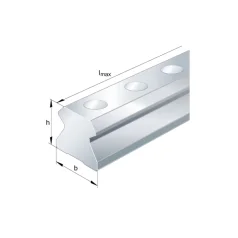
Displayed 20 from 411 products
Show more productsWhat are roller guides and what are they used for?
Roller guides are part of a profiled rail linear system. The rail is fixed to the supporting structure of the machine and defines the path of motion, while the carriage moves along it, carrying a table, tool holder, working head or another moving assembly.
The word "roller" refers to the rolling elements. Rollers recirculate inside the carriage and roll along the raceways of the rail and carriage. Because a roller contacts the raceway along a line rather than at a point, as a ball does, the contact area is larger.
As a result, roller linear systems generally achieve higher rigidity and load capacity than ball systems of a comparable size. This is important wherever the system would otherwise deflect too much under load or where high forces act on it.
Roller guides are mainly used in:
- machine tools and CNC machining centres,
- grinding and milling machines,
- presses, forming equipment and foundry equipment,
- heavy handling systems, gantries and conveyor systems,
- measuring and test equipment with large masses,
- special-purpose machines where high moments act on the linear axis.
This category contains rails only. The matching linear roller bearings – carriages are offered in a separate category, where you can choose a carriage that matches the size and system of the rail.
How a roller linear system works
A roller linear system consists of a rail and one or more carriages. The carriage has a built-in roller recirculation system: under load the rollers roll along the raceways, are deflected at the end of the carriage and return to the start of the load zone.
The rail has precision-ground raceways that are geometrically matched to carriages of the same system and size. The rail and carriage are therefore not freely interchangeable between different manufacturers or series; when selecting, always check that they belong to the same system.
In modern designs the load is distributed over several raceways, so the system takes up forces in different directions as well as moments about the longitudinal and transverse axes. The actual load ratings and rigidity values are specified by the manufacturer for the combination of rail and carriage, so they should always be taken from the catalogue for the selected system.
Main properties of roller guides
The properties of a roller guide depend on the profile size, manufacturing accuracy, mounting method and quality of the mounting surface.
The most important characteristics include:
- profiled rail with ground raceways for rollers,
- high system rigidity thanks to the line contact of the rollers,
- capacity for high loads and moments in combination with a suitable carriage,
- classification by sizes, which determine the matching carriages,
- manufacture in different accuracy classes,
- versions for mounting from above or from below,
- standard lengths that can be cut to the required dimension,
- possibility of assembling longer axes from several rails.
A roller guide alone does not determine the final accuracy of a machine. The result also depends on the flatness and rigidity of the supporting structure, the parallelism of the rails, the selected carriage preload and the installation.
Roller guides in the M&M Intercom range
At M&M Intercom we offer 400+ roller guide rails. The vast majority are Bosch Rexroth rails, complemented by Hiwin rails and a single FAG INA version.
The range is organised by manufacturer system, as the rail must match a carriage of the same series and size.
Bosch Rexroth RSA roller guides
Bosch Rexroth rails with the designation RSA are the core of our roller guide range. Our programme includes around 400 different versions.
They are available in sizes 25, 35, 45, 55, 65, 100 and 125. The size is shown in the rail designation, for example RSA-055 for size 55, and determines which Bosch Rexroth roller carriages are compatible with it.
The RSA rails in our range are 4000 mm long. Most versions have the type designation SNS, and BNS versions are also available to a lesser extent. The rails also differ in accuracy class and other codes in the product designation that the manufacturer uses to describe the version.
For some products, technical data is also given in the shop, for example for the rail RSA-055-SNS-P-MA-AK:
- length 4000 mm,
- mounting from above,
- hole spacing 120 mm,
- width 53 mm,
- height 47.55 mm,
- accuracy class P.
When ordering, it is advisable to state the full rail designation and the material number shown in square brackets, for example R180555231. This identifies the version unambiguously.
Hiwin RGR roller guides
Hiwin RGR rails are intended for Hiwin RG series roller carriages. In our range they are available in sizes 15, 20, 25, 30, 35, 45 and 55.
The rail designation contains the size, mounting method, length and accuracy class. For the rail RGR 20-T-4000-H, for example:
- RGR 20 – roller rail, size 20,
- T – version for mounting from below,
- 4000 – rail length in millimetres,
- H – accuracy class.
Version R for mounting from above and version T for mounting from below are available. Most RGR rails in our range are 4000 mm long, and some versions have lengths from 3900 to 3937 mm. All RGR rails in our range are in accuracy class H.
FAG INA TSX roller guide
Our range also includes the FAG INA TSX 25 rail with a length of 415 mm. This is a single version that is mainly of interest for maintenance and replacement in existing FAG INA systems.
With replacement parts of this kind, it is particularly important to check compatibility with the installed carriages and the actual dimensions of the existing rail.
Roller guide sizes and their significance
Size is the basic parameter when selecting a roller guide. With standard profiled systems, the size roughly corresponds to the rail width in millimetres, while the exact dimensions are specified by the manufacturer.
The rail size determines:
- the choice of compatible carriages,
- the load capacity and rigidity of the system,
- the space required in the design,
- the dimensions and arrangement of the mounting holes,
- the size of the fixing screws.
Overview of sizes in our range:
| Manufacturer and system | Sizes in our range | Rail length |
| Bosch Rexroth RSA | 25, 35, 45, 55, 65, 100, 125 | 4000 mm |
| Hiwin RGR | 15, 20, 25, 30, 35, 45, 55 | mostly 4000 mm |
| FAG INA TSX | 25 | 415 mm |
A larger size generally means higher load capacity and rigidity, but also greater mass, larger carriages and more space. The size should therefore be selected on the basis of a load calculation and the required service life, not just the dimensions of the existing design.
Accuracy classes of roller guides
The accuracy class describes the permissible deviations of the rail and system, for example in height, parallelism of the raceways and matching of several carriages on the same rail.
Manufacturers designate the classes with letters. For the Hiwin RGR rails in our range this is class H, while Bosch Rexroth RSA rails are available in several classes, for example H and P, as well as higher classes that the manufacturer indicates in the product code.
A higher accuracy class makes sense for machine tools, grinding machines and measuring equipment, where small path deviations are important. For conveying and handling equipment, a lower class is usually sufficient.
The rail and carriage must be selected in compatible accuracy classes. The exact permissible deviations for each class are given in the manufacturer's catalogue.
Mounting roller guides from above or from below
The rails are designed to be fixed with screws from above or from below.
When mounting from above, the screws are inserted through the holes in the rail and screwed into the supporting structure. This is the most common method, as installation is simple and accessible.
When mounting from below, the rail has threaded holes and the screws pass through the base plate. This version is suitable when the top surface of the rail is to remain free of holes or when the design only allows access from below.
With rails mounted from above, it is important that the holes are properly closed after installation so that dirt does not collect in them and the carriage seals slide smoothly over the rail. Protective caps and other elements are available for this purpose in the accessories for rail guides category.
Roller guide lengths and assembling longer axes
Most rails in our range are 4000 mm long. Such lengths allow long axes to be built or rails to be cut into shorter pieces for individual applications.
When determining the length, take into account the stroke, carriage length, distance between carriages, safety clearances and space for end elements.
When an axis longer than one rail is needed, several rails can be joined in series with suitable systems. The joints must be made according to the manufacturer's instructions so that the carriage passes over the joint without jolts.
When shortening a rail, it is important to maintain the correct distance between the first and last mounting holes and the end of the rail and to finish the edges properly after cutting.
Roller or ball guides – what is the difference?
In addition to roller guides, we also offer ball guide rails. Both systems have a profiled rail and a carriage, but they differ in their rolling elements.
| Property | Roller guides | Ball guides |
| Rolling element | rollers | balls |
| Contact with the raceway | line contact | point contact |
| Rigidity at the same size | generally higher | generally lower |
| Typical use | machine tools, high loads | automation, general mechanical engineering |
Ball systems are often more economical and suitable for many applications with medium loads where smooth motion is important. Roller systems are the right choice when forces, moments and rigidity requirements are higher.
Rails of the two types are not interchangeable, as their raceways are shaped differently.
Installing roller guides
Because of their high rigidity, roller linear systems are sensitive to errors in the mounting surface. Unevenness or lack of parallelism is not compensated within the system but increases the internal loads on the carriages.
During installation, consider:
- flatness and cleanliness of the mounting surface,
- locating the rail against the reference edge,
- parallelism and height alignment of two rails,
- the specified tightening torque and screw tightening sequence,
- correct orientation of the rail relative to the reference side,
- protection of the raceways against damage and contamination.
The exact requirements for the mounting surface, permissible deviations and tightening torques are specified by the manufacturer for each system and size.
Lubrication and maintenance of roller guides
Lubrication is carried out via the carriages, which have lubrication connections. The lubricant reduces friction and wear and protects the rail raceways against corrosion.
The type of lubricant, quantity and lubrication intervals are determined according to the system manufacturer's recommendations and the speed, load, stroke and environment. For grease lubrication, our range also includes greases and industrial pastes.
During maintenance, regularly check the cleanliness of the rail, the condition of the carriage seals and any damage to the raceways. Chips, dust and coolants can penetrate the carriage and accelerate wear, so additional protection is advisable in more demanding environments.
How to choose suitable roller guides?
A roller guide should always be selected together with the carriage, as the load capacity and rigidity apply to the system as a whole.
When selecting, take the following data into account:
- the manufacturer and system of the existing or planned carriages,
- the rail size,
- loads, moments and the required service life,
- the required accuracy class,
- mounting from above or from below,
- the required length and any joining of several rails,
- environmental conditions, such as dust, chips or coolants,
- the lubrication and maintenance method.
When replacing an existing rail, the most reliable starting point is the full rail designation and the manufacturer's material number. For a new design, start from the load calculation and the recommendations in the manufacturer's catalogue.
Roller guides from M&M Intercom
At M&M Intercom we offer 400+ roller guide rails from Bosch Rexroth, Hiwin and FAG INA. Bosch Rexroth RSA rails in sizes 25 to 125 and Hiwin RGR rails in sizes 15 to 55 are available, mostly in a length of 4000 mm.
Roller guides are part of our range of linear guides. In addition to rails, we also offer roller carriages, ball guide rails and carriages, linear guide sets of rails and carriages and accessories for rail guides.
If you need help selecting a roller guide, send us the designation of the existing rail or details of your application. We will help you find a suitable version in our range.
Frequently asked questions about roller guides
1. What are roller guides?
Roller guides are profiled rails for linear systems with roller carriages. The rail is fixed to the machine structure and defines the path of motion, while the carriage moves along it by means of recirculating rollers.
Such systems are used in machine tools, heavy handling equipment and other machines where high rigidity and load capacity are important. This category contains rails only; carriages are selected separately in the linear roller bearings – carriages category.
2. What is the difference between roller and ball guides?
The difference lies in the rolling elements. Roller systems use rollers with line contact on the raceway, while ball systems use balls with point contact.
Thanks to the larger contact area, roller systems generally offer higher rigidity and load capacity at the same size. Ball systems are often suitable for general automation and medium loads. Rails of the two types are not interchangeable.
3. Can I fit a carriage from another manufacturer on a Bosch Rexroth roller guide?
In general, we do not recommend this. Raceways, dimensions and accuracy classes are matched within the system of each manufacturer and series.
For Bosch Rexroth RSA rails, we therefore select Bosch Rexroth roller carriages of the appropriate size, and for Hiwin RGR rails, Hiwin RG series roller carriages. For any other combination, compatibility must be checked in the manufacturers' documentation.
4. Which roller guide sizes are available?
Our range includes Bosch Rexroth RSA rails in sizes 25, 35, 45, 55, 65, 100 and 125 and Hiwin RGR rails in sizes 15, 20, 25, 30, 35, 45 and 55. The FAG INA TSX 25 rail is also available.
The size determines the compatible carriages, the load capacity of the system and the mounting dimensions. It should be selected on the basis of the loads and the required service life.
5. How long are roller guide rails?
Most rails in our range are 4000 mm long. For Hiwin RGR rails, individual lengths from 3900 to 3937 mm are also available, and the FAG INA TSX 25 rail is 415 mm long.
Longer rails can be cut to the required length. This must take into account the stroke, the length of the carriages and the specified distances between the mounting holes and the end of the rail.
6. What does the accuracy class of a roller guide mean?
The accuracy class defines the permissible deviations of the rail and system, for example in height and parallelism. A higher class means smaller permissible deviations.
The Hiwin RGR rails in our range are in class H, while Bosch Rexroth RSA rails are available in several classes, including H and P. The rail class must match the carriage class; the exact deviation values are given by the manufacturer.
7. What do the designations R and T mean on Hiwin RGR rails?
The designations describe the rail mounting method. Version R is fixed with screws from above, version T from below.
Mounting from above is more common because installation is simpler. Mounting from below is chosen when the design allows access from below or when the top surface of the rail is to remain free of holes.
8. Can a roller guide rail be shortened or extended?
Rails can be cut to the required length, following the manufacturer's instructions on hole spacing from the end and edge finishing.
For axes longer than one rail, several rails can be joined in series with suitable systems. The joint must be made precisely so that the carriage passes over it without jolts or additional loads.
9. How are roller guides lubricated and maintained?
A roller linear system is lubricated via the lubrication connections on the carriages. The type of lubricant and intervals are determined according to the manufacturer's instructions and the load, speed and environment.
Regularly check the cleanliness of the rail, the condition of the seals and any damage to the raceways. On rails mounted from above, the holes must be closed so that dirt does not collect in them.
10. What information do I need to select a roller guide?
For a replacement, we need the full designation of the existing rail or the manufacturer's material number. For a new design, we need data on loads, moments, stroke, speed and the required accuracy.
The mounting method, length, environment and the carriage system the rail will operate with are also important. Based on this information, we at M&M Intercom will help you choose a suitable rail and matching carriages from our range.
Professional Consulting and Training
With years of market presence, expertise and experience, we find the most appropriate and cost-effective technical solution for your application.
More
Custom manufacturing of flat gaskets
Custom-made seals with precision up to 0.1 mm for all industries. High-quality materials, adaptable shapes, and fast execution. Solutions for extreme conditions.
More